Posts

A Nation of Queuers Cannot Stand

… They also serve who only stand and prate By Cedric Trevelyan, K.C.B.   I am not usually of a humour to give consequence to the middle classes taking their leisure, nor indeed am I even likely to encounter such creatures, given my more rarified social circles. But occasionally of late, whilst standing in line to procure my afternoon libation at one of the trendy coffee shops that have begun to dot my adopted homeland, I find myself rubbing shoulders with those beneath my station, and I cannot help but wince as I perceive how passively these humble folk, our good proles, endure the abuse dished up to them by certain surly concocters of caffeinated refreshments who, despite being only a missed paycheque away from penury and usually of a lower class than that of those upon whom they wait, nonetheless feel it their birthright to banter and visit amongst themselves at insufferable length before deigning to sullenly acknowledge the presence of their customers patiently standing be...
  So You Think You Understand Language By Jon N. Hall   The mathematician John von Neumann once said: “Young man, in mathematics you don't understand things. You just get used to them.” The same sort of thing might also be said about language -- you don't understand language, you just get used to it.   But with language, it may be even more the case than with mathematics. That’s because folks often have to invert the true meanings of words in order to grasp what they’re hearing, i.e. what’s intended. When one thinks about it for a bit, language itself can seem rather mystifying -- better to just use it, right?   Not if one is trying to be exact. It is for the sake of exactness and precision that we create “usage rules.” But we Anglophones need better usage rules for some of the most common words in English: conjunctions. Conjunctions can create ambiguity , and in some arenas of contemporary life, like law, ambiguity can’t be tolerated. Sad to say, but w...
Exciting New Discovery Challenges Conventional Wisdom                                                                       By Jon N. Hall   Paleontologists have recently unearthed compelling new evidence suggesting that for most of the early Pleistocene, the instincts of Man’s proto-human ancestors were severely attenuated. Although there are still disagreements in the scientific community over certain particulars of the raw data, some researchers speculate that some members of Australopithecus africanus may not have even sensed, however dimly, that they were related to and belonged with the others in their group. How, you may well wonder, could scientists know such a thing? More importantly, how could creatures so bereft even survive, much less take part in the long evolutionary march that ended with us...

TESTING EMBED CODE

Image
 
Forget Vaccines, Catch a Cold Instead By Jon N. Hall The Wuhan pandemic has been compared to the devastating Spanish flu pandemic of 1918, but the two differ in their victims. The Spanish flu hit young adults aged 20-40, a group that the Wuhan virus mostly doesn’t prey on. The Spanish flu also hit children, which our virus virtually ignores. I’m not an epidemiologist, but when compared to the Spanish flu, COVID-19 seems almost “benign.” The Spanish flu had a fatality rate of 2.5 percent , while the seasonal flu usually has a fatality rate of just 0.1 percent . Some research suggests that the fatality rate for Covid will ultimately turn out to be more in line with the seasonal flu than with the Spanish flu. And note that there’s a vaccine for the seasonal flu while scientists have yet to develop one for Covid. So if the latest fatality numbers hold, then Covid will turn out to be much less lethal than the Spanish flu. But calculating the fatality rate is difficult, and...
Nonsense ‘Carries Through’ the Anglophonic World By Jon N. Hall Before native speakers of the English language try to master the split infinitive, the passive voice, or the mysteries of the subjunctive mood, they might learn how to use conjunctions. Many Anglophones, even the highly educated, often don’t know which conjunction to use. One of the main reasons for this sad state of affairs is that for nearly a century, language experts, the guardians of our mother tongue, have been promoting a few bad ideas. I’m here to help. The rules of English language usage shouldn’t just codify the usage and logic of casual conversation. But that seems to be the case in a rule propounded by none other than Bryan A. Garner, usage expert par excellence . In my copy of the 2003 edition of the celebrated Garner’s Modern American Usage , all that one finds in the entry for the conjunction “or” is this: “See and/or. ” Garner’s entry for “and/or” is sound. Where we find the unfortunate rule for...
Image
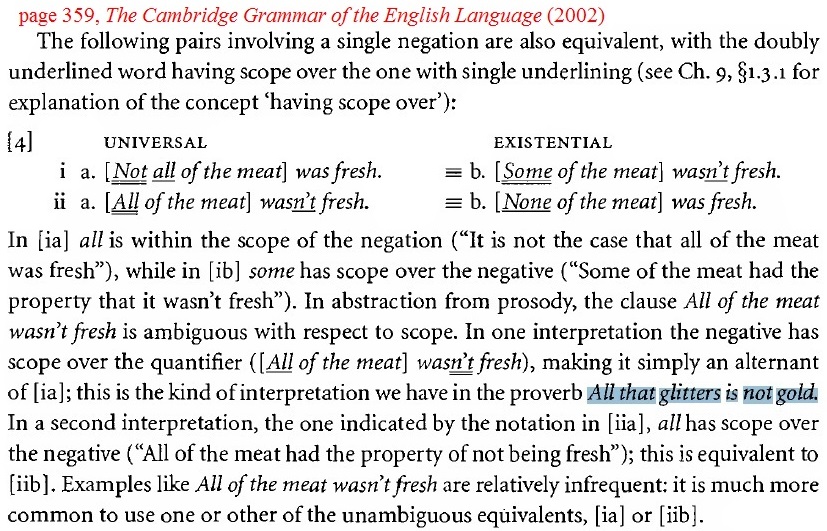
All that Glitters Is Not What? By Jon N. Hall January 10, 2020 The literal takeaway from the old adage “ All that glitters is not gold ” is that gold doesn’t glitter. In case you don’t know, that’s false, gold does in fact glitter. So we’re told that what the adage really means is this – Not all that glitters is gold. In the original form of our adage, “not” modifies “gold.” Therefore, “not” has scope over “gold.” In linguistics, a word’s scope is the part of a statement over which it operates. Some linguists contend that in our adage “not” can also have scope over “All.” This is the position taken by what may be the ne plus ultra of descriptivist grammars, The Cambridge Grammar of the English Language . The one reference in the CGEL to our adage is in the middle of page 359 (screengrab below), where the CGEL contends that “All of the meat wasn’t fresh” is akin to our gold adage in that it “is ambiguous with respect to scope. In one interpretation the negative has...