Nonsense ‘Carries Through’ the Anglophonic World By Jon N. Hall Before native speakers of the English language try to master the split infinitive, the passive voice, or the mysteries of the subjunctive mood, they might learn how to use conjunctions. Many Anglophones, even the highly educated, often don’t know which conjunction to use. One of the main reasons for this sad state of affairs is that for nearly a century, language experts, the guardians of our mother tongue, have been promoting a few bad ideas. I’m here to help. The rules of English language usage shouldn’t just codify the usage and logic of casual conversation. But that seems to be the case in a rule propounded by none other than Bryan A. Garner, usage expert par excellence . In my copy of the 2003 edition of the celebrated Garner’s Modern American Usage , all that one finds in the entry for the conjunction “or” is this: “See and/or. ” Garner’s entry for “and/or” is sound. Where we find the unfortunate rule for...
Posts
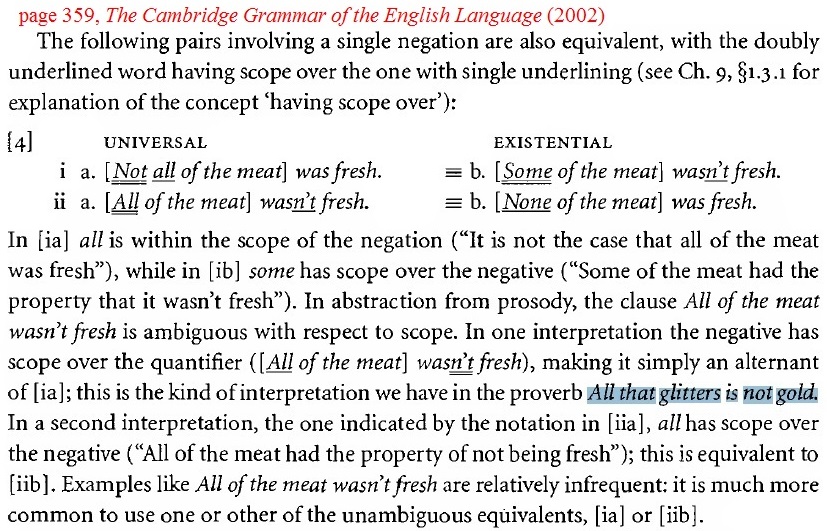
All that Glitters Is Not What? By Jon N. Hall January 10, 2020 The literal takeaway from the old adage “ All that glitters is not gold ” is that gold doesn’t glitter. In case you don’t know, that’s false, gold does in fact glitter. So we’re told that what the adage really means is this – Not all that glitters is gold. In the original form of our adage, “not” modifies “gold.” Therefore, “not” has scope over “gold.” In linguistics, a word’s scope is the part of a statement over which it operates. Some linguists contend that in our adage “not” can also have scope over “All.” This is the position taken by what may be the ne plus ultra of descriptivist grammars, The Cambridge Grammar of the English Language . The one reference in the CGEL to our adage is in the middle of page 359 (screengrab below), where the CGEL contends that “All of the meat wasn’t fresh” is akin to our gold adage in that it “is ambiguous with respect to scope. In one interpretation the negative has...

Helping Lawyers with Their Prose By Jon N. Hall President Trump wants to forge new trade agreements with other nations. He also wants to end the nearly 70-year conflict with North Korea and get a peace treaty. But what are treaties, trade pacts, and contracts if not language? Let’s hope the lawyers drafting such documents understand the conjunction “and/or.” In the third edition of Fowler’s Modern English Usage (1998), the entry for “and/or” reads: “First recorded in the mid-19c. in legal contexts, and still employed from time to time in legal documents, and/or verges on the inelegant when used in general writing.” On page 93 of Webster’s Dictionary of English Usage (1989), the entry for “and/or” presents an excellent little history of the term which lawyers should read: “ And/or thus began in a cloud of legal ambiguity, but such an inauspicious infancy proved no deterrent in its use.” The entry also alleges that “the interpretation of and/or became a matter of litigati...

H.W. Fowler and the History of an Error By Jon N. Hall October 7, 2019 For the last century or so, language experts have been having a hard time with the conjunction “nor.” For example, in his entry for NOR in The Penguin Dictionary of American English Usage and Style (2000), Paul W. Lovinger considers a perfectly grammatical construction, which he even admits “some grammarians would condone,” but still advises: “ Change ‘nor’ to or . ” What, pray, is wrong with “nor”? Lovinger never really explains. But he might try to understand how “nor” and “or” actually function and what they specify, for he also writes: “ Nor , like or , links alternatives.” Not so. The word “ alternative ” indicates choice. “Nor,” however, does not link choices; it links things which are all excluded, denied, disallowed, or negated. In the online Oxford English Dictionary , the fourth selection in the entry for NOR has this quote by W. E. Gladstone: “Not a vessel, nor a gun, nor a man, were on...

British Linguists Mangle Logic By Jon N. Hall September 30, 2019 The Cambridge Grammar of the English Language (2002) is a 1,842-page tome by Rodney Huddleston, Geoffrey K. Pullum, and thirteen other contributors. At the Cambridge University Press, the CGEL is touted as the “definitive grammar for the new millennium.” Well, a thousand years is a mighty long time, but at $324 one would hope that the claim would prove true for at least the beginning of the new millennium. So let’s see whether or not this descriptivist grammar can shed some light on a narrow issue that concerns conjunctions. (Forgive me if I anthropomorphize CGEL.) “Coordinator” is the term the CGEL uses for conjunctions, words like “and” and “or.” Chapter 15, “Coordination and supplementation,” is by linguists Rodney Huddleston, John Payne, and Peter Peterson. In section “2.2.2 And and or in combination with negation” on pages 1298-9 (or see screengrab below), we are assured that the following t...
The Limitations of Economics …I’m not an economist, but I play one on TV By Jon N. Hall NOTE : This article appeared in March of 2009 at James Glassman’s TCS Daily. I considered updating, rewriting, Americanizing punctuation, and testing the links, but decided to slap it up warts and all, just like I submitted it to Glassman’s now-defunct website. The article, of course, ran during the Great Recession, shortly after the financial crisis: Not so very long ago we often heard this: “The business cycle has been repealed”. Economics, it was suggested, was such a complete, mature science that the experts could engineer “soft landings”, sparing us the pain of recession and the heartache of depression. All we needed to do was put our faith in the economists. This was also about the time we heard about “the end of history”. In a book review from the summer of 1997, economist Paul Krugman wrote: Anyone who reads the business press knows that the mood these days i...